
If you've ever had conventional physical therapy it's likely you were assigned a home exercise program (HEP) averaging 5-100 exercises with a variety of sets, reps, and hold times. Maybe sometimes they seemed to help, other times not so much. Either way, studies show that people eventually abandon their HEP and their symptoms typically return. Many therapists then blame the recurrent symptoms on the lack of compliance with the HEP, which absolves them from any responsibility. While this may work for the therapist, it does not serve the patient very well.
I would suggest that there are several problematic factors in this model:
- Exercise is good, but it's typically not powerful enough to resolve fascial dysfunction. Fascial problems can be incredibly influential on many complaints be they musculoskeletal (muscles, tendons, joints, etc.) or internal (constipation, hypertension, urinary incontinence, etc.).
- Any approach that is counting primarily on exercise to be the main agent of change is not likely to be sustainably successful. Remember, people don't keep doing their exercises (and I can't say I blame them).
So what is the role of exercise and how should we approach it? It depends on the kind of exercise and the goal:
- Cardiovascular activities like biking, running, Zumba®, and swimming typically target the heart and respiratory systems.
- Strengthening activities like circuit or free weight training, Pilates, and calisthenics emphasize strengthening the musculoskeletal system.
- Flexibility activities like yoga and stretching target the mobility of the musculoskeletal and fascial networks.
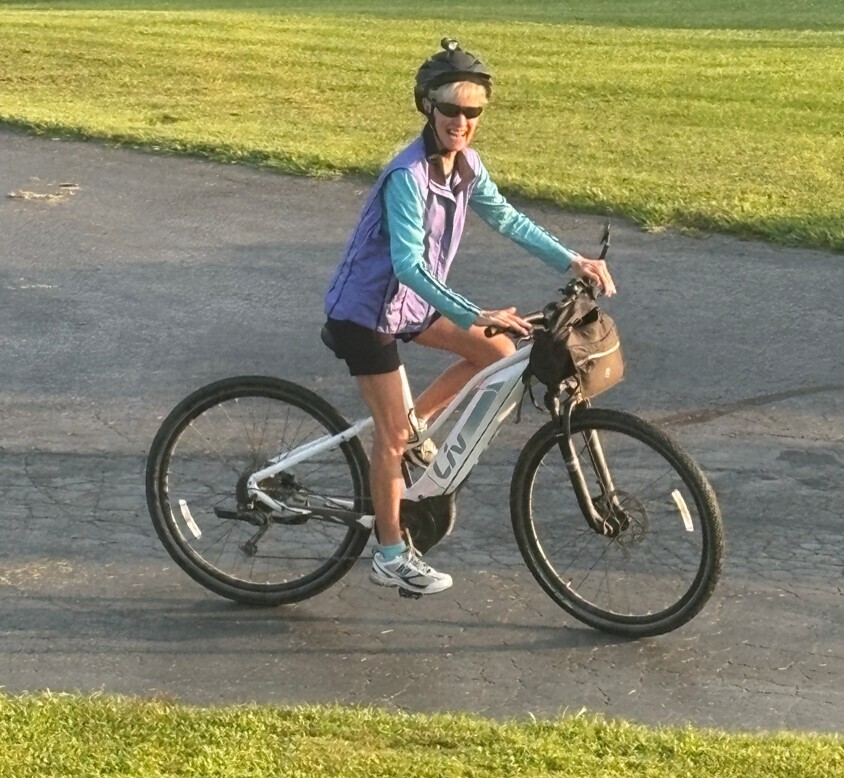
There certainly can be overlap between these general categories - biking also builds lower limb strength. Some approaches such as martial arts or exercise classes may address a combination of all these categories which is great; we need them all. Which category deserves priority depends on multiple individual factors such as one's daily activities (someone who sits all day needs to pursue exercise more intentionally than a Zumba® instructor). Resources such as time, money, and access to an exercise site also factor in. Personal preference is a big consideration: I am not a gym rat and would much rather be biking outside.
Maybe you've been faithfully performing your HEP but are disappointed that it has not resolved your shoulder, hip, or back pain. Perhaps this is because too much is being expected from exercise, and something else is needed. I find there are a few exercises that I believe support the changes made in the fascia with Fascial Manipulation®, but the exercises themselves are not the game-changer. Nonetheless they play a part in recovery. Here are my top 5 favorites with written descriptions, pictures, and videos.
A few general recommendations that apply to all of these:
- If this is a medical emergency then please call 911. HA!
- These exercises are my favorites, but are not necessarily right for everyone everytime. They may be uncomfortable as you work to reclaim lost range, but they should not be painful or make your condition worse. If this is the case then reposition, reread the directions, try again, and if it continues to have a negative impact for you then put it on hold. It may not be the right exercise for you or it may not be the right time. Your body is trying to tell you something - listen to it.
- Sets, reps, and hold times - lots of different opinions on this. I give some specific suggestions below, but it's not an exact science.
DOORWAY LUNGE
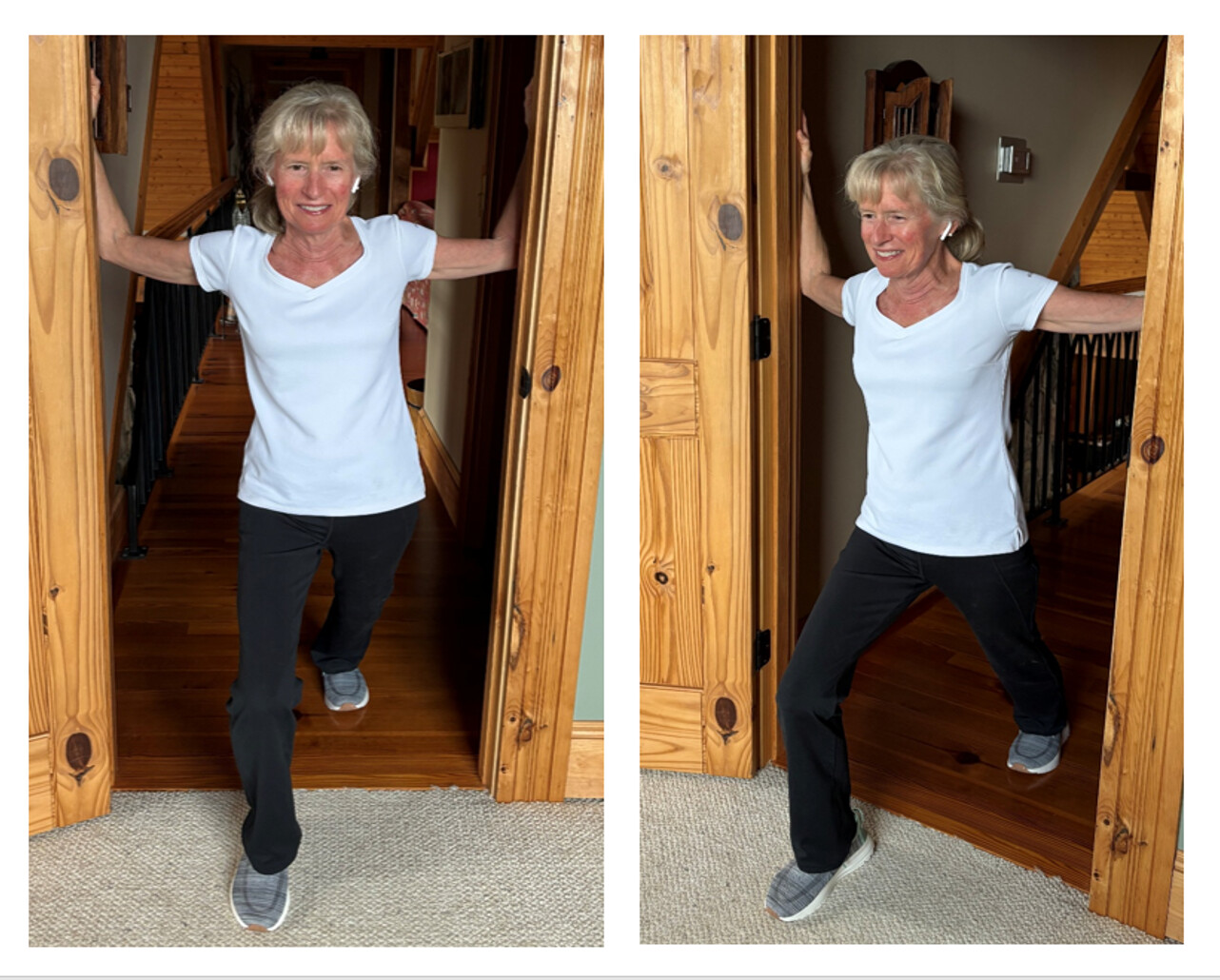
- Description: Stand in an open doorway and place the arms up on each side with the elbows at about shoulder height (or wherever they feel comfortable). Step through the doorway leading with one leg and bend that knee. Keep the knee of the back leg straight and the back heel on the ground. Be sure to keep the toes of the back leg pointing straight ahead - they like to turn out which makes the stretch less effective on the calf. Hold for 1 minute, repeat on each side.
- Target: Stretches the front of the hip (of the behind leg), the back of the calf (of the behind leg), and the front of the chest/shoulders. A restriction or problem in one are may influence how aggressive you can be at the other areas, so modify as needed.
- Frequency: for someone who sits a lot at least once daily or more if possible. Others at least once a week. A good stretch to do when sitting a lot with travel.
- Purpose: Counteract the effects of sitting, wearing heels, and arm use in front of us (computer, phone, reading, driving).
- Who needs this? Everyone who can do it safely, especially those who sit a lot.
Click HERE to watch video of Doorway Lunge Exercise
SIDE-BEND STRETCH
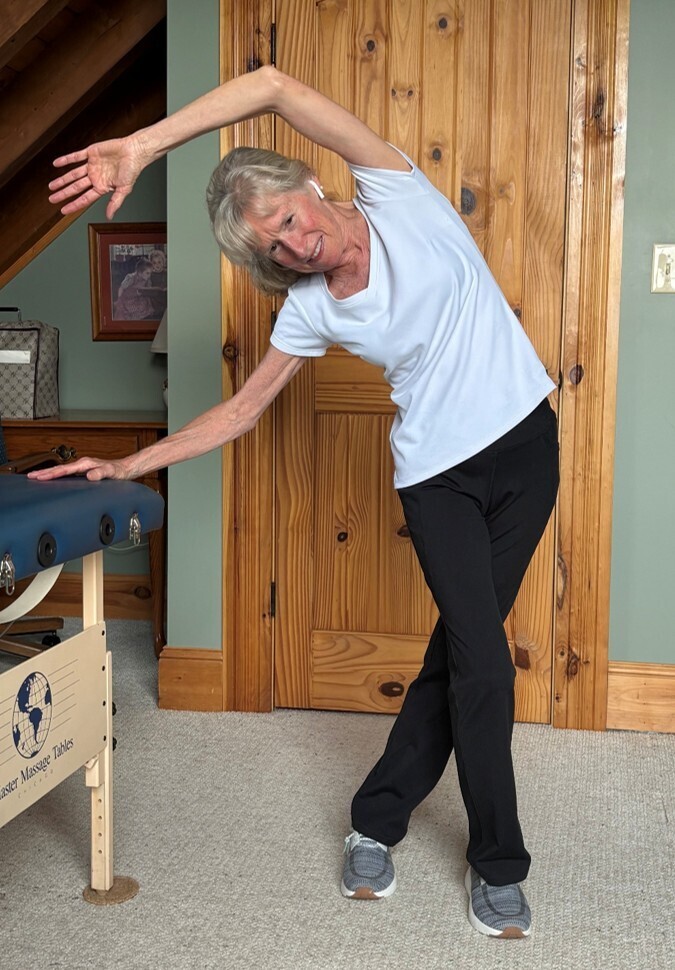
- Description: Stand next to a table or counter. Reach one arm upoverhead and place the other hand or forearm on the table / counter. Place the leg of the arm that's up behind the other leg. (If your right arm is up overhead then your right leg should be behind your left leg). Lean towards the table /counter bending sideways as far as possible. Hold for 1 minute each side.
- Target: Stretches the side of the arm, trunk, and lower limb.
- Frequency: for someone who is not regularly active once daily. Others at least once a week.
- Purpose: We rarely, if ever, in the course of a day elongate in this manner. If you don’t use it you lose it.
- Who needs this? Everyone who can do it safely.
Click HERE to watch video of Side-Bend Stretch
CHIN TUCK
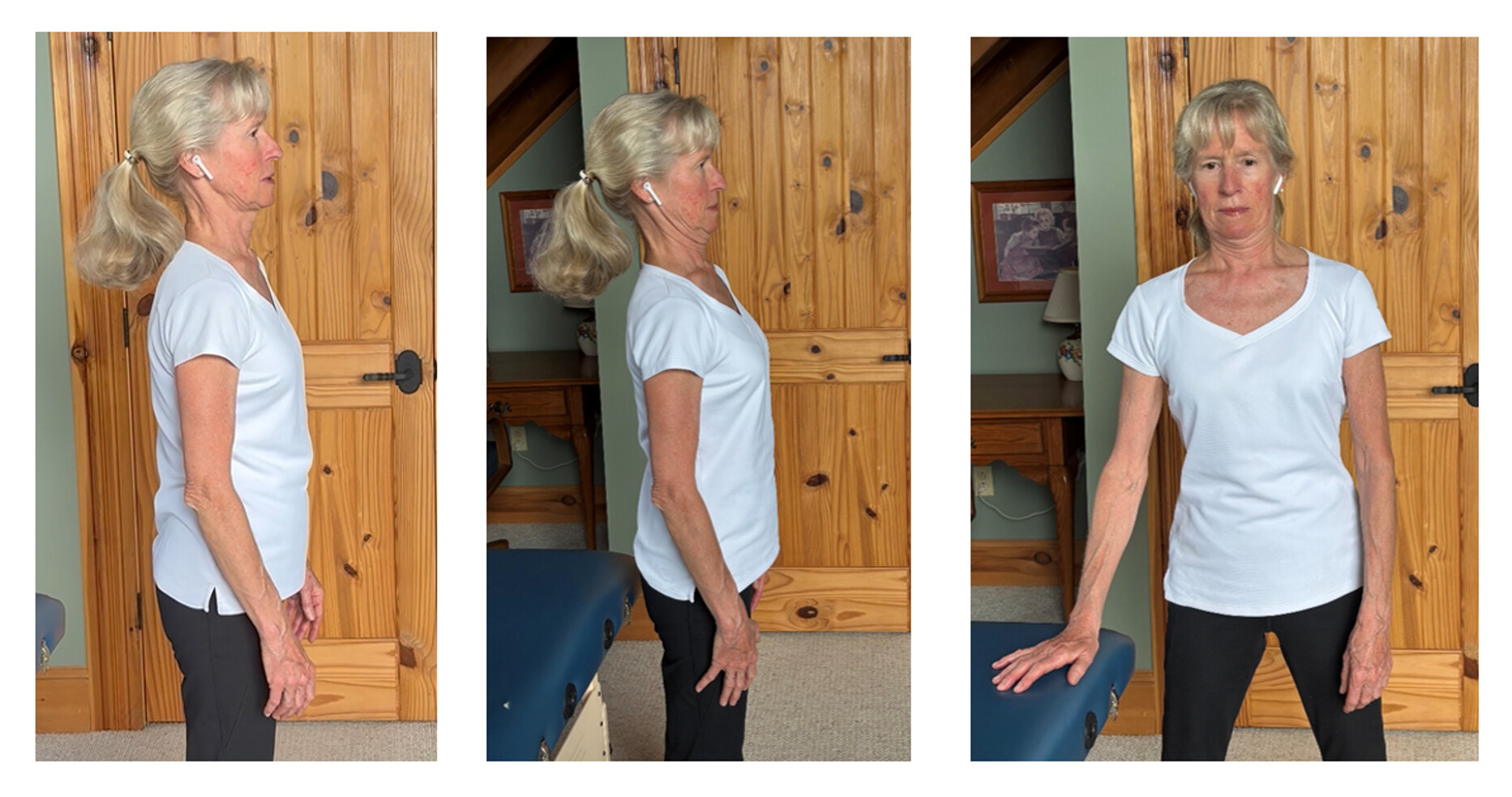
- Description: in sitting or standing gently glide the head backwards on the neck making a double chin. Keep the eyes level and avoid tipping the head backwards and looking up. Hold for ~ 10 seconds, repeat as needed.
- Target: Stretches the back of the neck by gliding the head back.
- Frequency: for someone who has a forward head, reads a lot, or is frequently on the computer consider doing this exercise once daily or more if possible. Others once a week.
- Purpose: Counteract the effects of a forward head posture.
- Who needs this? Everyone who can do it safely, especially those who have a forward head and rounded shoulder posture.
Click HERE to watch video of Chin Tuck
PELVIC BALL
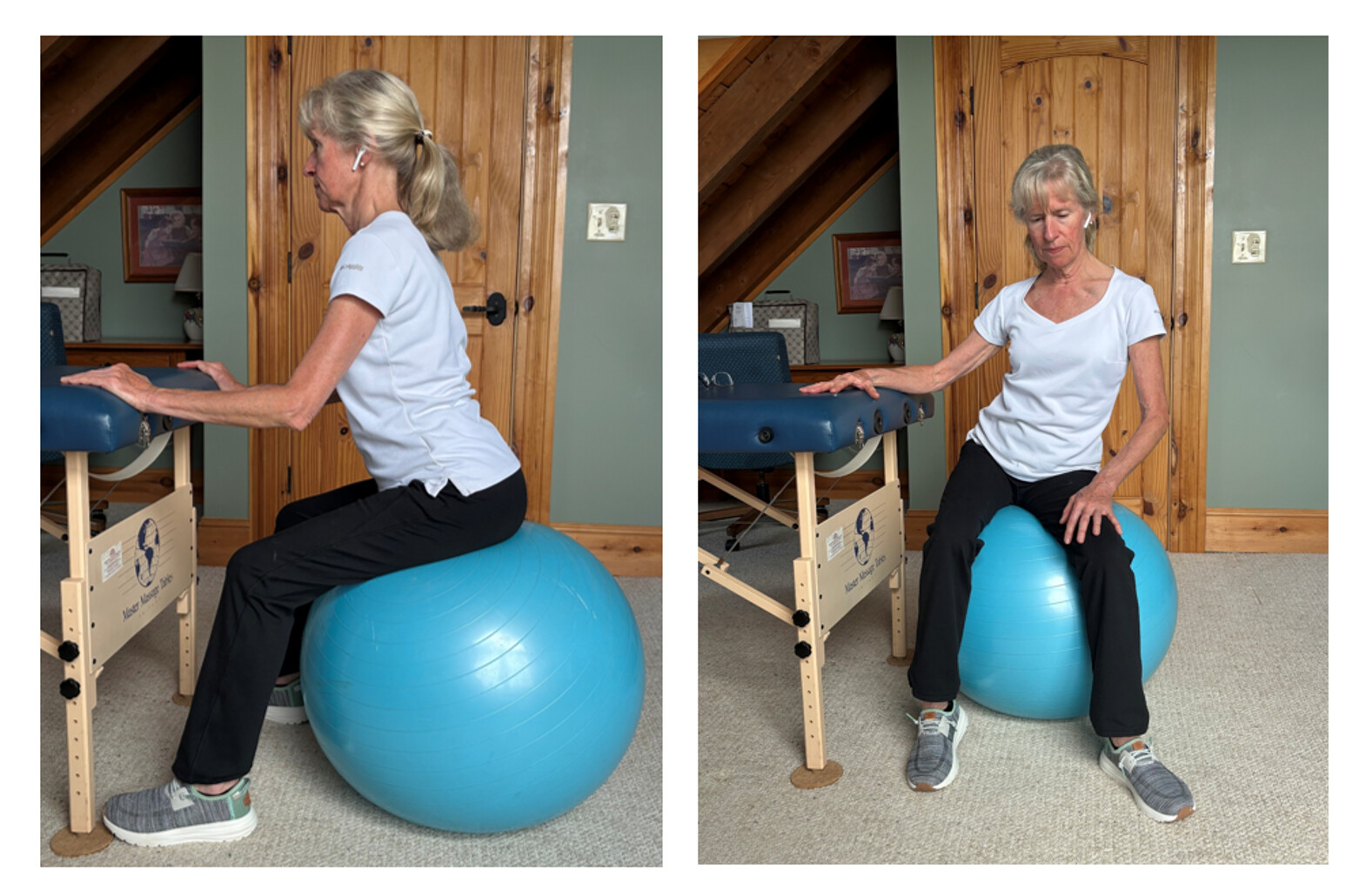
- Description: Sit on a therapy ball. People with balance issues should keep one or both hands on a stable surface such as a table. Keeping the upper body still and without moving the feet, roll the ball in different directions making all the work of movement come from the lower body. Rolling the ball front to back works the sagittal plane; rolling side to side works the frontal plane; and moving the ball in a circular direction works the horizontal plane, which can be done clockwise as well as counterclockwise. Work in all directions as long as you like.
- Target: Pelvic and lumbar segments (trunk).
- Frequency: daily/weekly as needed/desired.
- Purpose: Increase/maintain mobility and neuromuscular control in the core.
- Who needs this? Everyone who can do it safely.
Click HERE to watch video of Pelvic Ball
HULA HOOP
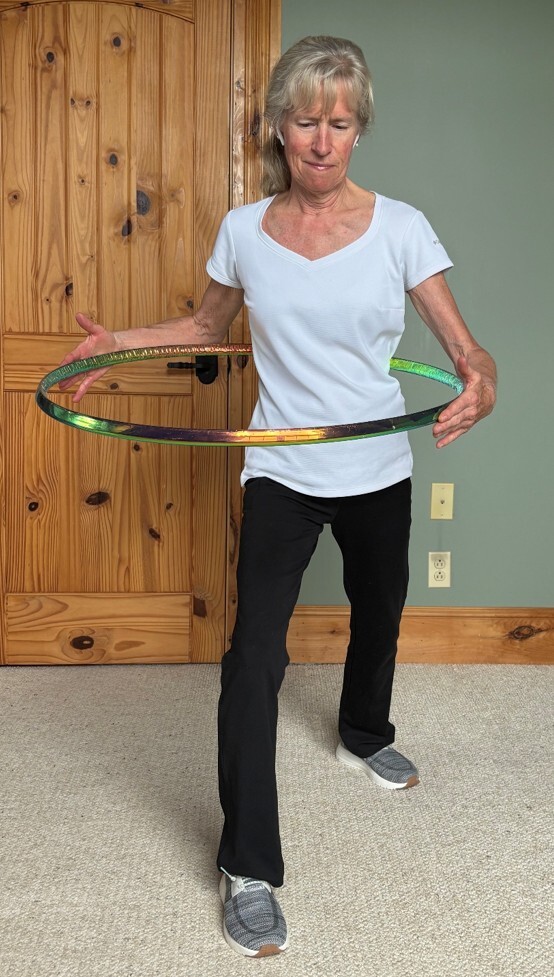
This one needs no explanation! This is one of the best, safest, and funnest core exercises there is! Many people can’t do this, and often say they never could even as a child. But if you can't hoop then I would suggest this signals a deficit that needs to be addressed. Consider beginning with the Pelvic Ball (see above), and progress to the Hula Hoop. Not all hula hoops are the same – cheap, small, light ones can be impossible. Some suggestions:
- Best Position - most people have a position they find easiest and strongest (for me this is with the right leg forward). Start with this, but then change it out to challenge your body in a different way: put the other leg forward, stand with both legs even, try to move the feet closer together. You can even try walking while keeping the hoop going.
- Best Direction - for me this is counter-clockwise, I have no idea why. It's fine to begin with this, but try to reverse the hoop direction to work your body differently.
- Increase the Challenge by working in a manner that is not your easiest and best.
Click HERE to watch video of Tips on HULA HOOP, and click HERE to watch me go!
Wishing You Health & Joy!
Colleen

.jpg)
