
I have been impressed with the Fascial Manipulation® - Stecco method (FM) since I was first exposed to it in 2014. Results compelled me to immerse myself in studying, practicing, and eventually becoming certified as an FM clinician and instructor. As part of my obsession with life-long learning (and needing to obtain CEU's) I recently enrolled in a fascia course not too far from home which pertained to a completely different fascial model, called Fascial Counterstrain (FCS). I had heard of Strain Counterstrain (SCS) over the years but was not drawn to it as there did not seem to be much evidence supporting it. I went to the class with low expectations.
To say I was blown away by the course would be an understatement! I was astonished and overwhelmed with the content which included lectures, demonstrations, and labs for us to practice techniques on each other. Within the first two hours of the first day most of us in the class were signing up for the next class - something I have NEVER seen happen. I was not the only one who was impressed. Strong and compelling evidence was presented throughout the weekend testifying to the science behind what we were seeing, hearing, doing, and feeling.
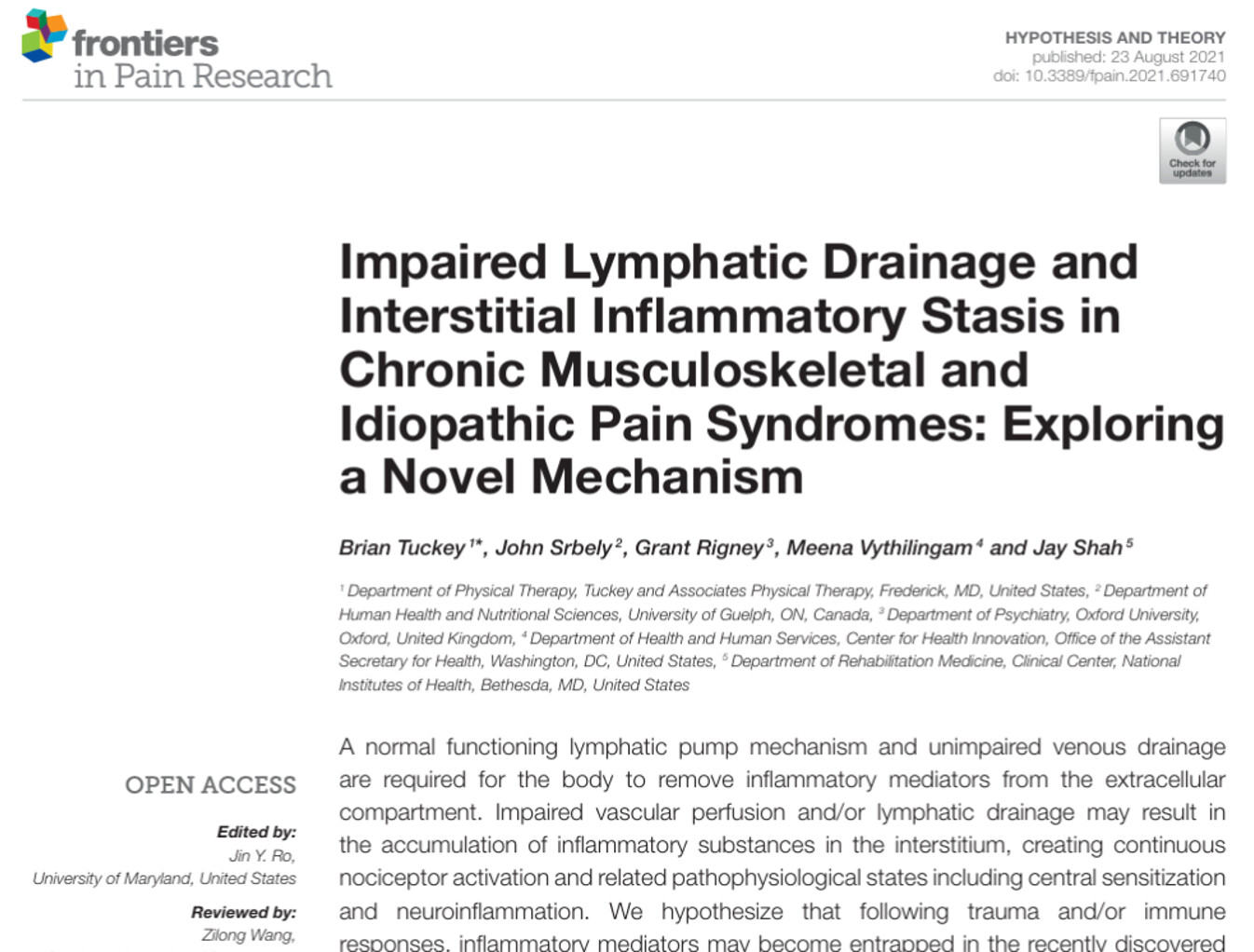
Here is an amazing article proposing new theories behind pain and pathology. You can openly access this article here.
One major article was written by the course's lead instructor, Brian Tuckey, who is a physical therapist trained in osteopathic and visceral manipulation techniques. He proposes that most persistent pain stems from failure of the lymphatic system to flush out the interstitium (the space surrounding cells of the fascia) causing stagnation, pain, inflammation, and potential pathology to organs and joints. His 2021 article has been cited far more than most scientific papers and is creating quite a stir in the world of pain management. Over the years he has worked to expand upon and update the SCS techniques and theories of his mentor, osteopathic physician Leonard Jones, based on new science and understanding. The SCS model focuses primarily on the musculoskeletal system, while FCS includes the fascia of the organs.
Much like FM, FCS uses palpation to identify dysfunction throughout the body. But then the two techniques diverge. FM uses a knuckle or elbow to release adhered fascial layers. FCS uses positioning to place and hold distressed fascia at ease, stimulating the lymphatic pump to clear out the stagnated region. One example of this is with persistent muscle guarding and shortening, which is often a protective mechanism. The body is not going to let the musculoskeletal system move in a way that will damage a vital structure like an artery or lung. Your brain would rather throw your neck, hip, or knee under the bus as opposed to letting you move in a way that may damage a vital structure. This could explain why so many musculoskeletal treatment interventions fall short, and why stretching the hamstrings or hip flexors may never make a change. One advantage of FCS over FM is that it is a gentler, less painful approach which some prefer.

So now I am working overtime to integrate this material and revise my clinical paradigm, which is not easy or enjoyable as many of you may appreciate! But I believe it will be worth it, and I'm seeing results which is gratifying. I'm not abandoning FM; rather, I'm using both approaches as it seems appropriate for the person and the problem. I like the idea of having something else I can use for people who cannot tolerate FM, and for those who plateau or are not responding.
I'll close with a story. In 1985 I slid on ice and hit a stalled salt truck on an interstate exit ramp in Atlanta. This was the start of problems in my left neck/scapular/upper back region. My wonderful husband, Bill, has treated me over the years with a variety of techniques, and I am currently much better than I used to be. But I am still subject to flare-ups. After I had covid the first time I was in such severe pain in my left scapular/upper back region that I went for an X-ray to rule out rib fracture or pneumonia, which was negative. Eventually that flare-up calmed down, but I've never had full resolution. Then I recently developed a flare-up of this region for no particular reason, and once again Bill worked on me. After four days with minimal change I asked him to use a FCS technique to release the fascial lining of the lung, called the pleura. He did so and I got up from the table significantly improved. Who says you can't teach an old dog new tricks?
If treatment with FM has been successful for you then great! But if it's too aggressive or you have stopped improving consider the alternative fascia approach of FCS. Give me a call, send a text, or book a session with me to determine what you need. You have options: act on them!
Wishing You Health & Joy,
Colleen

.jpg)
